The Touchline Is Not the Whole Matchday
Matchday can feel richer when you choose one role beyond watching every play, from welcoming newcomers to keeping a simple record of the fixture.
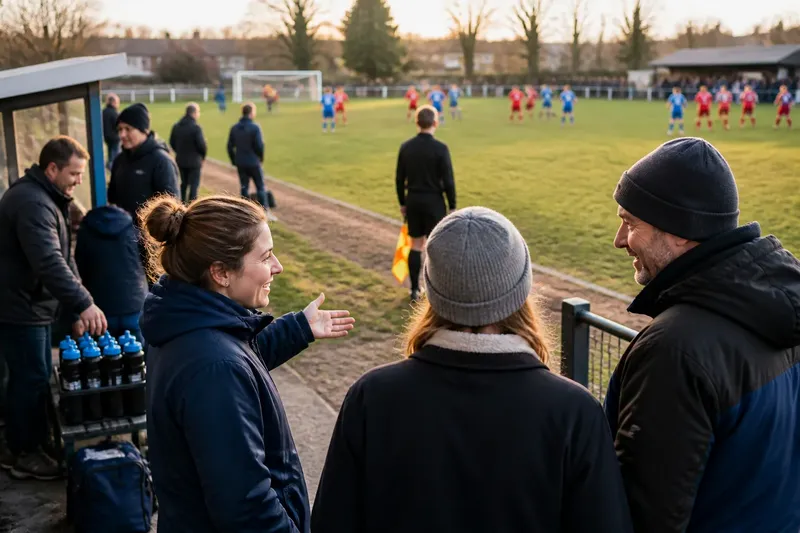
Matchday does not have to mean watching every moment from the touchline. At a local fixture, you can enjoy the occasion by choosing one small focus—welcoming a newcomer, keeping an eye on the team’s shape or helping with a practical task—then letting the rest of the day unfold around it.
Choose a focus
A match is busy by nature. Players move, the ball changes direction, and people on the sideline talk, organise equipment and keep track of what is happening. Trying to notice everything can make a relaxed afternoon feel like a test of concentration.
A focus is simply a reason to be there beyond following every touch. It might be social, practical or observational. Choosing one helps you take part without pretending that support requires constant attention.
For instance, say you arrive at a community football match with a friend who has not visited the club before. You might make your focus helping them find the right pitch and introducing them to someone on the sideline. Once they feel settled, you can watch together or take a break; the expected result is that both of you have a clearer way into the day.
Roles beyond watching
Supporters can contribute in ways that suit their time, energy and relationship with the team. A role need not be official, and it need not last for the whole fixture.
- Welcome someone: Say hello to a visiting family, a new player or a person who looks unsure where to stand.
- Notice a pattern: Follow one simple feature, such as how the team uses the width of the pitch, rather than trying to assess every player.
- Keep company: Sit with a relative or friend who would enjoy conversation as much as the action.
- Help with a small task: Ask the team contact whether a non-specialist task, such as carrying a water bottle crate, is useful and appropriate.
- Make room for rest: Step away from the sideline for a quiet moment, a drink or a walk around the venue.
These roles are not substitutes for duties that require training or permission. If a task involves officiating, first aid, safeguarding or access to restricted areas, leave it to the appropriate person and follow the club’s arrangements.
Watching selectively
It is possible to watch with attention without tracking every play. Pick something visible and understandable: how players spread out when their team has possession, how a runner returns to support a teammate, or how the group responds after a mistake.
This kind of attention gives the match a thread. You are not scoring anyone’s performance; you are noticing one part of how a team works together. If the pattern becomes hard to follow, choose another focus or simply enjoy the atmosphere.
For a spectator who is new to the sport, the simplest focus may be learning the basic flow: when play pauses, where the teams gather, and what the referee’s signals appear to mean. There is no need to know every rule before being welcome at a local fixture.
Make the day comfortable
Matchday enjoyment also depends on the setting. A muddy touchline, a windy stand or a crowded entrance can change what feels manageable, especially for children, older relatives or anyone who finds noise tiring.
Think ahead about ordinary comforts: a waterproof layer, shoes suited to the ground, a drink, and somewhere to sit if the venue has seating. Check the club’s fixture information for access, parking or food arrangements rather than assuming each ground is organised the same way.
Agreeing on a flexible plan can help a group. One person might watch the opening spell, another may take a short walk with a child, and everyone can meet again at a clear place. The plan is a convenience, not a rule that anyone must follow.
What should you focus on?
Can I leave the touchline during play?
Usually, spectators can take a break in an appropriate public area, but the venue may have boundaries around the playing area. Follow posted signs and any directions from club staff, and choose a safe route that does not cross active play.
What if I do not understand the sport?
Choose something you can see without knowing the full rulebook, such as how teammates communicate or where play tends to move. You can also ask a companion one specific question rather than trying to learn everything at once.
How can children enjoy a fixture?
Offer a small, optional focus: notice the team colours, spot a particular player’s role or help carry a snack. Keep the invitation light, and let them move, rest or stop watching if their attention shifts.
Should I volunteer on matchday?
Ask the club contact what help is needed and what the role involves before agreeing. A brief, clearly understood task may suit you better than an open-ended commitment.
Let attention shift
A chosen role should make the fixture easier to enjoy, not turn it into another obligation. If you began by following the play and find yourself drawn into a conversation, that is a perfectly sound change of focus; the match is still happening around you.
The touchline is one place to take part, not a test of how closely you watch. For a more enjoyable matchday, choose one focus that fits the people and conditions in front of you, then give yourself permission to change it when the day asks for something different.