The Club Volunteer Rota, Before the Group Chat
A club volunteer rota makes shared jobs visible, clarifies each turn and helps members choose a fair way to contribute without relying on chat reminders.
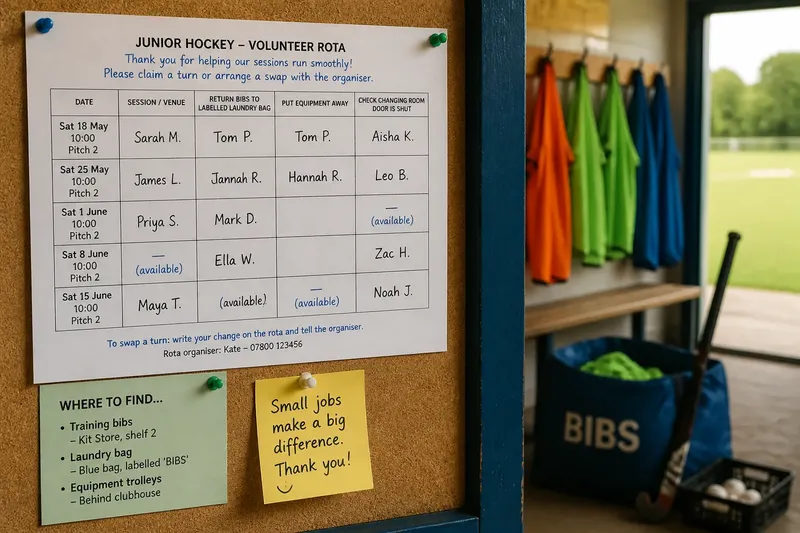
Who is bringing the bibs back, opening the clubhouse or staying to put equipment away? A club volunteer rota answers those questions before they disappear into a group chat, where messages can be missed and responsibility can remain vague. The point is not to make every member do the same thing; it is to make each task and its turn visible enough for people to take part on terms that fit.
Start with the job
A rota is a shared record that connects a task with the person or small team taking a turn. It might be a paper sheet on the club noticeboard, a table in a shared document, or a printed page beside the kit store. Its format matters less than whether members can see what needs doing and who has agreed to do it.
Begin by listing the recurring jobs that support sessions and matches. Use plain descriptions: “return training bibs to the laundry bag” is clearer than “kit”; “check the changing-room door is shut” is clearer than “close up”. A task should describe a manageable action, not a whole department’s worth of invisible work.
Separate a task from the person who usually does it. If one familiar volunteer has been opening the equipment shed for years, the rota can show that opening is a club job, not an unexplained personal habit. That distinction gives others a chance to learn the routine and lets the usual volunteer step back when needed.
Choose by situation
The right rota depends on the club’s size, schedule and members’ circumstances. A sheet that works for a regular weekend squad may be awkward for a club with several age groups and changing venues. Sort the arrangement by the problem you need to solve, rather than copying a format because another club uses it.
For a small, regular group
Use a short paper rota if the same people meet at the same place and can see a noticeboard or kit-room door. Keep the list to a few repeatable jobs, and write a name beside each turn. This suits a group that can make changes in person and does not need a separate digital account to stay informed.
For several teams or venues
Use one shared document with a separate section for each team or location if members otherwise struggle to find their own duties. Put the venue and session beside each task, so “put equipment away” is not mistaken for a job at another site. A single document is useful only if someone keeps its layout clear and members know where to find it.
For members with changing availability
Use a sign-up rota with unclaimed turns if attendance varies from week to week. Members can choose a task that matches a session they already plan to attend, rather than being assigned a date they cannot make. Keep a named organiser responsible for noticing gaps; an open slot is visible, but it does not fill itself.
For a club with a few reliable volunteers
Use a rota that pairs a regular volunteer with a second person who can learn the task. This is more suitable than moving every job between unfamiliar people when an activity needs local knowledge, such as knowing where a particular set of cones is stored. The second person should have a real turn, not merely be listed as a possible back-up forever.
Make each turn clear
A useful entry tells a member what to do, when the turn applies and where the necessary materials are. If a job depends on a key, a labelled box or a club procedure, add a short note or point to the place where that information lives. Keep the rota itself brief; detailed instructions belong in a separate club note when the task needs them.
Agree how turns are assigned. A rotating order can suit a stable group that attends regularly; voluntary sign-up can suit members whose schedules differ. Some clubs will need a mixed approach, with a volunteer choosing a slot for ordinary jobs and a named organiser covering essential tasks that remain unclaimed.
Fairness does not always mean identical duties. A member who cannot arrive early might take a later task, while someone who is not able to carry equipment could handle a sign-in sheet or return borrowed items. Ask what people can reasonably take on, and offer alternatives without asking them to explain private circumstances to the whole group.
Set a simple way to swap turns. Members might write a change on the paper sheet, update the shared document, or tell the rota organiser, depending on the club’s arrangement. The important detail is that the person taking over knows about the change; a private message between two members may leave the visible record wrong.
Keep it visible
Place the rota where the task happens or where members naturally gather: near the kit store, clubhouse entrance or team noticeboard. If the club uses a shared document, name it plainly and link to it from the place members already check. Avoid relying on a new app for a small rota unless members have a practical reason to use it.
Make it easy to scan. Group jobs by session or venue, leave space to write a swap, and distinguish an unclaimed turn from a confirmed one. A member should be able to tell at a glance whether a task has an owner, rather than having to search a long thread for the latest answer.
Say you help run a fictional junior hockey squad whose parents often ask who will collect training bibs after practice. You add “return bibs to the labelled laundry bag” to a noticeboard rota, list the next few sessions, and invite families to claim a turn or arrange a swap with the organiser. The expected observable result is that each session has a visible name beside the task, and the group can see an empty slot early enough to discuss it.
When should the rota change?
What belongs on a volunteer rota?
Include recurring, bounded jobs that members can understand and complete as part of normal club activity. Keep one-off events and specialist responsibilities separate unless they genuinely recur and have a clear handover.
How often should turns rotate?
Choose an interval that matches the task and the club’s attendance pattern. A task that happens at every session may need a turn each time, while a less frequent clubhouse job may fit a broader schedule.
What if nobody claims a turn?
Leave the gap visible and ask the rota organiser to raise it with the relevant group before the session. If the job is essential, the club needs an agreed arrangement for covering it; quietly assuming the same volunteer will step in keeps the responsibility hidden.
When is a group chat useful?
Use chat to announce a change, ask for a swap or point members to the rota, rather than treating the message history as the rota itself. The visible record remains the place to check who has a turn, while chat can help people coordinate around it.
Review without blame
After the rota has been used for a while, ask whether tasks were clear, whether turns fitted members’ availability and whether any jobs repeatedly went unclaimed. Treat a missed turn as information about the arrangement, not an invitation to shame someone in front of the club. A task may need a clearer description, a different time or a smaller share of responsibility.
For club volunteer rota planning, keep the central question practical: can a member see what is needed, recognise a manageable turn and know how to change it? When the answer is yes, a rota makes contribution easier to share before another message is sent. Keep a named person responsible for maintaining the record, but let the work itself belong to the club.